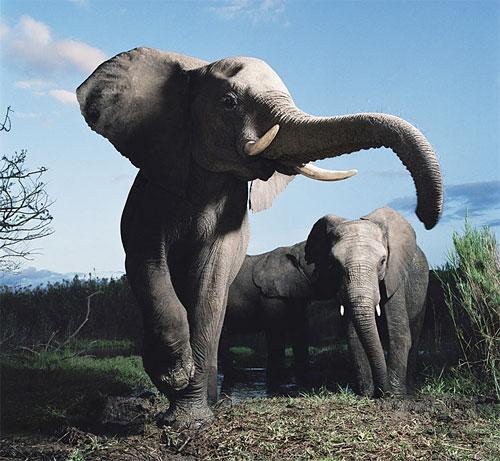
Elephants
Elephants are one of the most exciting and endearing of wild animals!
Most people know that modern elephants fall into two sub-species: the African
elephant (Loxodonta africana), and the Asian elephant (Elephas
maximus). But few people can really explain the differences between
the two -- other than continents of origin and perhaps ear size
and shape.
Here's the low down on the two basic types:
African
Elephant
(Loxodonta
africana)
|
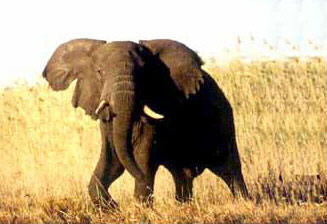 |
Height:
shoulder
height of males up to approximately 13 feet high (290cm);
Weight:
13,
200 pounds (7,500 kg) maximum.
Body shape:
Flat forehead. Concave back (dips down, like a horse or cow).
Tusks:
Large. Present in both male and female.
Trunk:
"Two-fingered". |
Habitat:
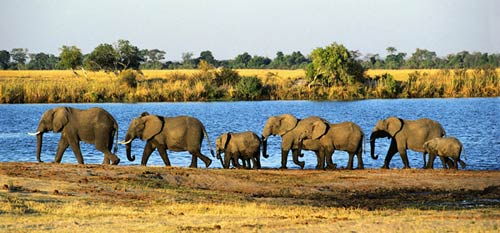
The largest living land animal, the African elephant lives both on
the grasslands (savannahs) and in the forests. African elephants in
grasslands regions tend to live in larger groups than those who live
in the forests. In fact, savannah elephants may join together in
loosely knit clans of up to 70 members! But most often they can be
found roaming about in a basic family unit of about 10 elephants.
According to the
WWF,
important populations of African elephants occur in Tanzania,
Botswana, and Zimbabwe, and probably in Congo, Gabon, and the
Democratic Republic of Congo.
Asian Elephant
(Elephas maximus)
|
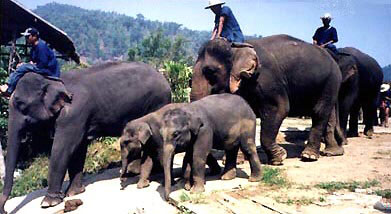 |
Height:
10 feet at
shoulder
Weight:
14,000
pounds maximum.
Body shape:
Two
large bumps on forehead.
Flat or rounded back.
Tusks:
Small.
Usually only present in males.
Trunk:
"One-fingered".
|
|
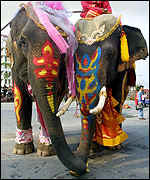
Domestication:
Asian elephants have been trained and domesticated by humans for thousands
of years. They have been used in trade and construction for their
abilities to lift and haul large or heavy loads, in transportation to
add endurance and splendor to the travels of kings and warriors, and
in entertainment events and religious rituals to infuse awe and power.
Habitat:
Asian elephants live in a variety of habitats including open grasslands and
marsh lands, but are better known as denizens of Asia's lush tropical forests.
|
 |
Basic Facts About
Elephants
Did
you know...
 Elephants
live approximately 70+ years. Elephants
live approximately 70+ years.
Although
massive, they can run at speeds of up to 25 miles per hour and trample
almost anything in their way.
An
elephant will lose and regrow its teeth six times during its lifetime.
A
healthy adult elephant has little to fear from predators, except human
beings. It's greatest threats come from poachers and habitat loss.
Elephants
can communicate with each other over great distances using infrasound,
vocalizations that are at such low frequency they cannot be heard by the
human ear.
Elephants
are highly
intelligent creatures with very large and complexly organized brains.
Not only do they have the largest brain of any land animal, but the
structure and complexity of their brains is similar to that of a human.
Unlike
your dog or cat an elephant can actually reconize itself in a
mirror. Other animals that share this trait include dolphins,
apes, magpies, and of course humans.
Elephants
are the largest land mammal yet their closest living cousin is the
diminutive
rock hyrax. Another close relative is the manatee.
Contrary
to a popular old myth elephants are NOT afraid of mice, but they do try to
avoid bees and ants.
The
skin of an elephant is about one inch thick yet so sensitive that it
can feel a fly land.
An
elephant's trunk is prehensile, meaning that it can be used to grab,
hold, and move objects. An elephant's trunk has over 150,000
muslces but no bones.
Social
Structure
Elephant society is organized
into two main groups: a male-centered bachelor group and a
female-centered family herd.
The female family herd is not exclusively
female. Baby males and young teenage males also live in this group.
But the group largely consists of adult females, their
babies, their other female relatives (sisters, aunts, cousins) and
their offspring. Because this group is held together by ties
to or between the adult females, or mothers, this group is also called "matrifocal",
or mother centered. The group is led by the most senior adult
female, also known as the "matriarch".
The matriarch has acquired decades of knowledge
and experience that helps her lead the herd to the best feeding and
watering sites during different seasons of the year and over vast
distances. If there is not enough food and water to support the
entire family herd it will break up into smaller groups that can forage
separately. Matriarchs can use both scent gland secretions and
infrasound (low frequency rumblings) to help them detect their sister
bands even when many miles away.
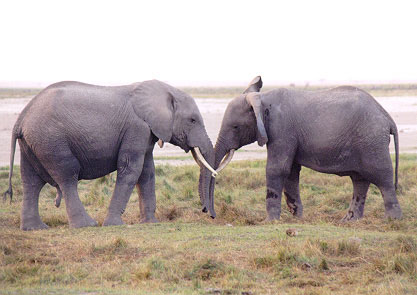 The
male centered or "bachelor" herd is made up of adult males and
the older teenage males. Young males seem to follow a senior bull
male, a kind of patriarch whom they watch and learn from. The
male centered or "bachelor" herd is made up of adult males and
the older teenage males. Young males seem to follow a senior bull
male, a kind of patriarch whom they watch and learn from.
All male elephants start out life as babies living
with their mother in the matrifocal group. But as they mature they
began straying from her more and more often and seeking out other young
males. Young males enjoy play fighting and testing their strength
against each other, an activity that prepares them for the real battles
they will engage in as older bulls. By age thirteen or so these
young males are ready to leave the protection and guidance of their
mothers and aunties and begin their life in the bachelor herd. A
bachelor herd is usually made up of four or five bulls, but there may be
as many as thirty roaming together.
Although the two groups may live very far apart, adult males know
exactly when a female has entered into the rare and very brief
stage during which she can can become pregnant (also known as "estrus"). Suddenly males
appear as if out of nowhere, arriving right on time to mate with the
receptive female.
Life
Cycle
Like all mammals, an elephant starts it's life
inside its mother's womb. Like most large mammals, the
elephant takes a long time to develop, requiring a long pregnancy or
"gestation". But elephant gestation takes much longer than
any other mammal, on land or in the sea. In fact it takes an
incredibly long 22 months to develop and grow before it is ready to be
born. That's almost two years!
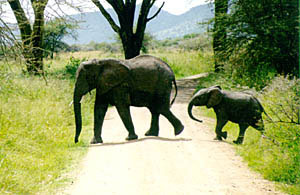 But
the mother elephant's work is still not done. She will spend the next
five years nursing her baby and protecting it from predators as it learns
the fundamentals of elephant life. And even once the baby is
weaned, it will continue to live with its mother and aunties. The
herd protects the still developing youngster and helps it find water
holes, mud wallows, and good grazing and foraging sites. But
the mother elephant's work is still not done. She will spend the next
five years nursing her baby and protecting it from predators as it learns
the fundamentals of elephant life. And even once the baby is
weaned, it will continue to live with its mother and aunties. The
herd protects the still developing youngster and helps it find water
holes, mud wallows, and good grazing and foraging sites.
As noted above, in social structure,
by the time a young male elephant hits puberty he will drift off to join
a bachelor herd. However if the adolescent is a young female
elephant, she will continue to live in her mother's herd, learning from
the older females and helping to look after her younger siblings and
cousins. By the time she is 12 to 14 years of age she will begin
having her own babies.
The young male elephant, meanwhile will not be
ready to mate for another ten years. And in fact, because access to
females in estrus is fiercely fought over by the more senior bull
elephants, he may not get a chance to reproduce until he is 35 or 40
years old!
Threats
To Survival
Poaching:
Most
people know that elephants have long been hunted for their ivory. In
fact, in the 1970s half the elephant population of Africa disappeared
― ruthlessly slaughtered for their ivory tusks. But did you also
know that in 1989, an international ban was imposed on the ivory
trade? That means that while it is still legal to sell ivory within
one's own country, it is illegal to export it to other countries
(which is how the big money was made).
Unfortunately,
many tourists still purchase ivory trinkets and art objects while
visiting African and Asian countries, and some people believe that it
would be okay to allow some export of ivory, just to help out the
economies of various African nations. Certainly we should not turn a
deaf ear to the needs of our fellow humans, but is murdering such an
exceptionally intelligent creature really the right solution?
In addition to being threatened by the ivory
trade, Asian elephants are also hunted for their hide and bone. In
Thailand the hide is turned into shoes and hand bags. And in China
the bone is is turned into bone ash and used in traditional medicines
treating ulcers of the skin and stomach.
Habitat loss:
An
even greater threat to elephants than poaching may
be habitat loss. Nearly everywhere that elephants live, there are
human beings looking to turn the elephants' wild feeding and breeding
grounds into domestic farm and ranch land. An elephant is a very
large animal. Grass and leaves are not very calorie rich foods.
Therefore, an elephant herd requires a vast territory to range over
in order to consume enough plant food
without stripping their
feeding area bare. As elephants are forced onto smaller and smaller
range territories, there is greater and greater threat that the very
trees, bushes, and grasslands that support the elephants will become
so badly damaged that they will no longer be able to re-grow
themselves and thus no longer be able to feed the elephants
or
all the other wild animals that feed there.
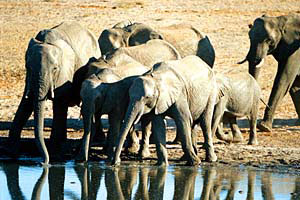 Habitat Fragmentation
-
Now
that human beings have encroached so heavily on elephant habitats,
it is not always possible for elephants to follow their normal
migration paths. When elephants try to ignore the crops, fences, and
other structures in their way, the local human residents get very
alarmed. Human attempts to drive elephants away sometimes leads
to elephants being injured, accidentally or deliberately. Similarly, the critical overlap
of human and elephant habitats means that sometimes it is the
elephants who accidentally harm the humans.
Habitat Fragmentation
-
Now
that human beings have encroached so heavily on elephant habitats,
it is not always possible for elephants to follow their normal
migration paths. When elephants try to ignore the crops, fences, and
other structures in their way, the local human residents get very
alarmed. Human attempts to drive elephants away sometimes leads
to elephants being injured, accidentally or deliberately. Similarly, the critical overlap
of human and elephant habitats means that sometimes it is the
elephants who accidentally harm the humans.
Even when the elephants are not being attacked
however, this human disruption of the migration path is still doing
harm. First of all, elephants are unable to access the vast feeding areas that
they need (see Habitat Loss, above).
And secondly, elephants may become cut off from other elephant groups
or subgroups. As a result family ties, social interaction, and
mating are then disrupted.
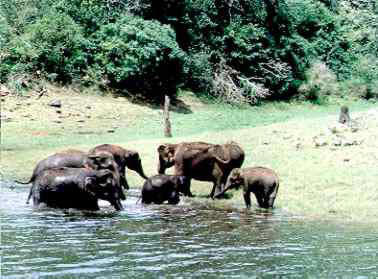 High
Risk Capture Procedures
In Asia many people would rather capture a wild elephant and train it
than purchase one. Additionally, they find it much more attractive to
have a large, productive adult elephant
now, than to breed
elephants and wait ten years for the babies to grow up.
High
Risk Capture Procedures
In Asia many people would rather capture a wild elephant and train it
than purchase one. Additionally, they find it much more attractive to
have a large, productive adult elephant
now, than to breed
elephants and wait ten years for the babies to grow up.
But unfortunately, many
of the methods of capture used too often result in the death of the
elephant. Thankfully programs are currently underway to encourage rural people
to discontinue this risky methods, and to educate them successful
methods of raising their own elephants. But providing information
will not be enough. The fate of these wild elephants depends on the
willingness of human beings to act with compassion and integrity.
Interesting
Links About Elephants
|
African Elephant
More fascinating facts
about African Elephants from Nat Geo KIDS.
Elephant
Anatomy
An exciting page that gives the
"inside" story about elephants! Great animated
illustrations and close up photos!
Field
Notes
Read the field notes of real scientists
studying elephants on location in Africa.
An Elephant Never Forgets...
Want to learn even more elephant facts?
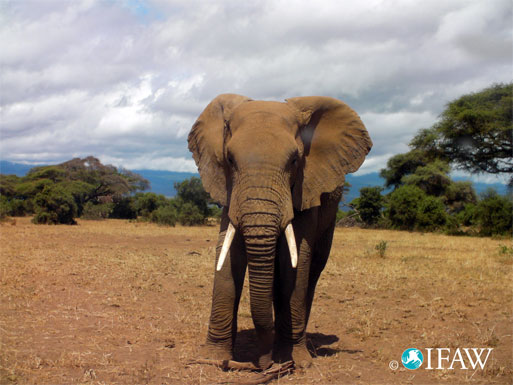
Just watch this outstanding
video
from from IFAW! This lengthy video is jam packed with
fascinating information about all aspects of elephant life.
|
|
|
|
Our
Favorite Books About Elephants
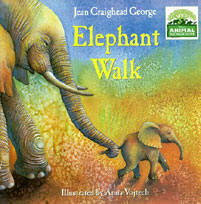
Elephant
Walk
Written
by Jean Craighead George, Illustrated by Anna Vojtech
Poetic and heartwarming, this
charming tale of a baby elephant named Odon introduces the reader
into the subtle and sensual world of elephant family life. Young
children will relate to Odon's struggle to master the everyday
challenges that seem so simple for adults and older siblings-- they
will also relate to his elation over his eventual success! But what
makes this book far and away a winner is the fascinating two-page
spread at the back of the book illustrating "Elephant Talk".
Illustrations and text explain what elephants are communicating to
each other when they engage in different postures and embraces. The
best one is illustrated by the cover art above -- this mother
elephant is saying, "I love you baby!" Written by Newberry
Award winner Jean Craighead George, and magically illustrated by
Czech born artist Anna Vojtech, this book is perfect for children
aged 5-8. To buy this book,
click
here.
ELEPHANT
WOMAN:
Cynthia
Moss Moss Explores The World Of Elephants.
by Laurence Pringle.
Illustrated with photographs by Cynthia Moss.
Meet Cynthia Moss, a renowned elephant
researcher in Kenya, Africa. Learn about the family structure, social
life, and communication processes of elephants, as well as the story of
how Moss came to devote her life to the study of these fascinating
animals. Engaging photographs accompany informative text. Index. Further
Reading List
|
|
 Woolly
Mammoth: Life, Death, and Rediscovery
Windsor Chorlton.
Illustrated with photographs. 40pp. Woolly
Mammoth: Life, Death, and Rediscovery
Windsor Chorlton.
Illustrated with photographs. 40pp.
This story
emphasizes the excitement and enormity of the project to
excavate and remove a frozen woolly mammoth. The
experience highlights the expertise and technology
needed for such a venture. Several new discoveries are
illustrated and old theories are reinforced. The project
is brought to life by brilliant photographs and
illustrations. Websites, Index, Mammoth Sites and Finds.
|
|
Elephant Quest
Written and illustrated by Ted and Betsy Lewin
Ted Lewin's realistic paintings and Betsy Lewin's field sketches
illuminate this four-day, real-life trip to Moremi Reserve in Botswana,
Africa. This work is an adventure story that introduces the reader to the
region's wildlife and ecology. African Elephant Facts, Index. |
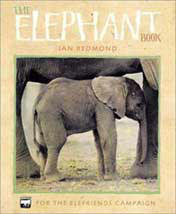
The Elephant Book
To benefit the Elefriends Campaign
by
Ian Redmond. Illustrated with photographs.
We can replant forests, and
even reclaim deserts in time, but no one, when the last elephant has
gone, can make another." Biologist Ian Redmond pays tribute to the
pachyderm in The Elephant Book, with breathtaking photos of the
African landscape. Divided into sections such as "The Architect of
Africa," "Trunks and Tusks" and "Peaceful Coexistence," and peppered
with quotes from the likes of David Attenborough and Jane Goodall, the
book seeks to stop the ivory trade and eliminate poaching. Half the
royalties go to the Elefriends Campaign, an elephant protection group
based in London.
Elephant Games, Crafts, & Activities
|
Activities to do at home or at school...
The Elephant Game
Increase attention span,
promote body awareness and refine motor coordination, develop a keen sense of observation,
and more!
No supplies needed! 6 or more players. This game works well for even large groups too.
Elephant Coloring Pages
A variety of pictures to print and color, from the silly and simple to the simply stunning.
Elephant Origami
Teaching Guide and Lessons
From
IFAW.org, the International Fund for Animal Welfare.
|
|

Learn while you play,
with these online games...
Elephant Odyssey
Travel back in time 200,000 years and guide your Columbian Mammoth on a journey as you test
your knowledge of elephants in this animated trivia game.
Elephant Themed Games
Shockwave required.
|

Send us some email!
|