| |

Explore Earth's
Kids
Climate Change & Global Warming
What
Everyone Should Know... And What Each of Us Can Do About It.

We On February 17, 2005 Scientists at the Scripps Institution of Oceanography reported that they had found clear evidence of human-produce warming in the world's oceans. The evidence, they say, "removes much of the uncertainty associated with debates about global warming."
It should be noted here that the Scripps Institution of Oceanography is one of the oldest, largest, and most important centers for global science research in the world. This announcement by the scientists as Scripps sounds the death toll to an era of heel dragging, shoulder-shrugging, and outright denial of the scope and reality of the problem.
Unfortunately there will likely remain those who, for the sake of short term financial gain, political power games, and intellectual hubris will continue to deny the need to take action. And yet as author and scientist David Brin has pointed out, just as ordinary citizens leapt into action to respond to the crisis of the 911 disaster, so too do we ordinary citizens have the ability and responsibility to raise up our awareness and assess what we can do in any crisis that threatens our lives, our nations, and the welfare of our children.
To help our readers share this issue effectively with the children in their lives, and to join with them in taking constructive action to slow global warming and in motivating our government to do the same, we have included a summary of the global warming situation, a list of common myths about global warming (as well as the facts which dispel them), a quick overview of the key indicators that global warming is already in progress, and some great information to help you take action on this critical problem.
If you're ready to do something to help your community, nature, and
the planet, then check out our
Kids Can Change the World pages to discover simple things that you
can do to make a difference. Just remember, we can accomplish
even more when we work together with others! So if you
would like to form your own Earth's Kids chapter, check out
KIDS CLUB and send us some
email about becoming a chapter leader! KIDS CLUB is for those
who want to get out in nature to learn and discover and to
work together to make a positive difference for our planet through
greening your lifestyle, doing simple service projects, and expanding
your knowledge about nature. But most of all... KIDS CLUB is
about having
fun!
Global Warming, A Summary
While some people still think global warming is just a fairy tale invented by the Chicken Littles of the world, the
reality is that
global warming is a fact of life acknowledged by all mainstream scientists. It is irrefutable.
Not too long ago there was considerable argument over
whether the measured rise in temperature over the last hundred years is
a normal cycle of nature, or a human-caused phenomenon.
But in 2001 a panel representing virtually all the
world's governments and climate scientists agreed that
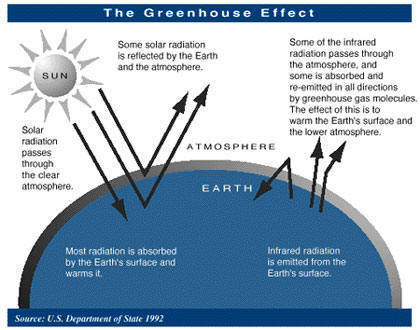
Earth's atmosphere was warming at a rate without
precedent during at least the last 10 thousand years.
They also agreed: this warming was not merely a natural
cycle within nature, but rather it was caused by the
buildup of greenhouse gases from human activities as car
exhaust and the burning of fossil fuels to generate
electricity.
But
skeptics continued to dismiss this learned consensus
with a wave of the hand and an assortment of rabid,
often conflicting remarks. Now the landmark announcement by the Scripps Institution of Oceanography
(February
17, 2005)
provides scientific evidence tantamount to the legal
trial's "smoking gun" -- it really is happening,
it really is man-made. But there is good news in
this too -- changes in human
actions should make a difference in the future of
the global warming trend.
For
some time scientist have predicted that global warming
will cause
rising sea levels, permanently
submerging current coastal areas, islands, and some other low-lying regions. The cause is simple: the
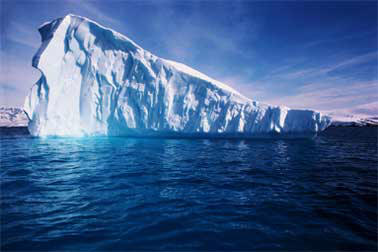
polar ice packs will begin melting. Secondly we have all realized that global warming means hotter temperatures
generally, and more severe summer heat waves. This may in turn lead to water shortages and even power shortages as
air conditioners and refrigeration systems work over time.
 But now scientists are finding evidence that shows that not only are the polar ice packs
melting, but the snow
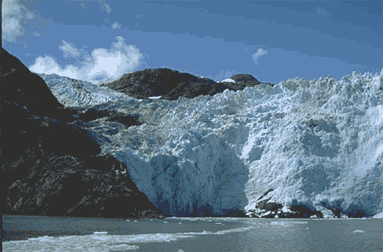
packs atop the world's major mountain chains are also melting earlier in the season and building up in lesser volume.
This latter finding means increased water run-off during the rainy season leading to
flooding, extreme erosion and mud
slides, followed by droughts
in late spring and summer (when melting snow run-off would normally feed streams). The
higher level of summer temperatures may also cause more moisture to evaporate from the land, as well as from streams
and reservoirs -- meaning yet more threat of drought.
The incidence of heat induced deaths is also expected to
rise. But now scientists are finding evidence that shows that not only are the polar ice packs
melting, but the snow
packs atop the world's major mountain chains are also melting earlier in the season and building up in lesser volume.
This latter finding means increased water run-off during the rainy season leading to
flooding, extreme erosion and mud
slides, followed by droughts
in late spring and summer (when melting snow run-off would normally feed streams). The
higher level of summer temperatures may also cause more moisture to evaporate from the land, as well as from streams
and reservoirs -- meaning yet more threat of drought.
The incidence of heat induced deaths is also expected to
rise.
Naturally these kinds of changes will
cause harm to animal habitats,
threaten the survival of rare and endangered plant
species, disrupt agriculture (heightening the threat of
famine), and endanger human homes. Many animals, rodents and insects
that carry infectious diseases, may be forced to migrate from their present homes in search of food and water, as
well as more comfortable or more stable living conditions.
As the news of these developments spread, children have
already been asking us if they will one day have to
explain to their grandchildren... what a polar bear was.
Indicators that Global
Warming Is Already in Progress
Facts, figures and other information from UCS
As you read the facts and
figures below, you will notice that some of them seem
pretty small and unimportant. But what you will
notice, before you are through, is that the Earth
changes created by a small rise in temperature are
already accelerating in size and frequency of
occurrence. Keep this in mind when you hear people
repeating the same old myths about global
warming. Don't be afraid
to speak up and set them straight!
-
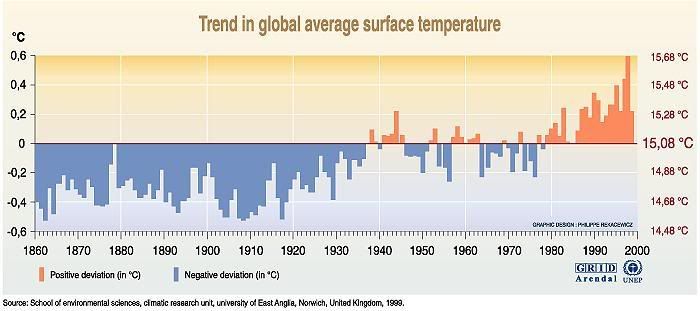
Seven of the ten warmest years in the
20th century occurred in the 1990s.
1998, with global temperatures spiking
due to one of the strongest El Niños on
record, was the hottest year since
reliable instrumental temperature
measurements began.

The Top Ten Myths About Global Warming
Read these popular
myths about global warming, then read the
accompanying science fact that shows the real
situation. Now you'll know what to say the
next time you hear someone repeating one these
myths!
|
Myth:
It isn't really
happening |
Fact:
Documented science
overwhelmingly shows temperatures rising
rapidly. |
|
Myth:
It's natural |
Fact:
Temperature increases, especially since the
1970's, are far above natural variations. |
|
Myth:
Any effects well
be very gradual |
Fact: not only are severe storms
getting stronger, but climate history shows
sharp climate changes can occur abruptly, in
only a few years. |
|
Myth:
It does not affect the U.S. |
Fact:
The U.S. is experiencing rising sea levels,
more severe storms and droughts, die-off of
forests, altered animal migrations, and loss
of glaciers such as those in Glacier
National Park.
|
|
Myth:
It will be good for us |
Fact: Some areas may become
more pleasantly warm, but the cost of
negative effects will far outweigh any
benefits; disease and heat deaths are
increasing.
|
|
Myth:
Agriculture will
benefit |
Fact: CO2 may make some crops
grow faster, but also will accelerate weeds,
pests and droughts; crops may not grow well
where they once did as climate zones shift.
|
|
Myth:
It's being handled by
our government |
Fact: The current U.S.
Administration advocates studying, not
dealing with, global warming; its
energy policy completely based on burning
more coal & oil. Most state and
local governments are unprepared for major
changes. |
|
Myth:
It's not a big deal
compared to national security
|
Fact:
Global
warming is actually the most serious threat to
the widest range of human concerns. Our
national and world security is
directly threatened by negative climate effects
on weather, water supply, disease, agriculture,
marine resources, and health. |
|
Myth:
Technology will solve
the problem for us |
Fact:
Massive "fixes" like burying greenhouse
gases are very unlikely, but many smaller
changes can make a difference AND are
available now. |
|
Myth: There's nothing to be
done anyway |
Fact:
Everyone can make a
difference today! Check out the solutions
in the next section... |
adapted
from World View of Global Warming
by Gary Braasch
What
Each of Us Can Do About the Problem
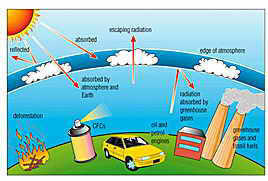
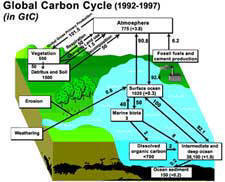 To understand how to slow global warming, we
have to understand what causes it. Essentially there are
things we humans do and use that release heat-trapping gases and
particles into the air. What are these things? The
biggest causes are 1) the ongoing destruction of the world's forests
and 2) the burning of fossil fuels like oil, gas, and coal.
The harmful gases released include carbon dioxide, methane, and
nitrous oxides. To understand how to slow global warming, we
have to understand what causes it. Essentially there are
things we humans do and use that release heat-trapping gases and
particles into the air. What are these things? The
biggest causes are 1) the ongoing destruction of the world's forests
and 2) the burning of fossil fuels like oil, gas, and coal.
The harmful gases released include carbon dioxide, methane, and
nitrous oxides.
The main solutions therefore are:
1) Saving our
forests and replanting those forests that have been destroyed
2) cutting back on our use of fossil fuels, and
3) making sure that
when we burn fossil fuels we take measures to prevent the gases
listed above from escaping into the atmosphere.
As private individuals there are a number of
things we can do to support these goals, both in the areas of
personal action, and through the pressure we bring to bear on our
governments and businesses to comply with practices that slow global
warming.
Listed below you will find our list of specific
things that you can do. We ask that you not only choose a few of
these items to take action on, but that you pass this information
along to all of your friends, family, and work associates. We
can make a difference. But first we must acknowledge
that something must be done, and then... take action!
Some Further Suggestions....
Global Warming Materials For Educators
We Can Make A Difference!
-- Advice for
Kids, from the EPA
The United Nations Climate
Change Information Kit (pdf)
Saving the Environment
-- More resources from Earth's Kids
Earth Day
-- Tons of idea and resources for helping our
planet.
-
Make Your Homes
More Energy Efficient --
The more electricity our appliances, lighting,
heating, cooling, and entertainment consumes, the
more fossil fuels are burned to produce electricity
for our homes! We can all help by turning off
the lights and the TV when we don't really need them
on and by changing our outfits (sweaters/tank tops)
instead of adjusting the thermostat up or down,.
And don't forget, when it's time to replace your
light bulb, choose maximum energy efficiency!
Most of us leave our lights on, all our lights on,
for many, many hours. It all adds up.
Also when it comes to selecting new electronics and
appliances, look for the Energy Star symbol.
This means your buying a product that is highly
energy efficient. Finally, don't
forget to unplug appliances that you're not really
using -- especially freezers! Read these
Tips from the
EPA's Energy Star Program
for tons more information.
-

Choose Green Transportation!
Walk, Bike, or take Public
Transportation! Okay, not everyone can choose one of
these to get to work or to the other important places
they must go. But you can think before you drive.
Consolidate errands so you make fewer car trips.
And talk to friends, neighbors, and co-workers about
carpooling. Even if you only do it a couple days a
week, you're making a significant reduction in
greenhouse emissions. Also, when it comes
time to buy a new car, think a high fuel efficiency
rating -- maximum miles per gallon means less fuel gets
burned, and less toxins released into the atmosphere.
For more help choosing a car, don't miss the
The
Green Guide to Cars and Trucks.
-
Use and Support Cleaner
Energy Sources
--
Did you know that half the power
plants in the U.S. burn coal to fuel the
generators that produce our electricity?
And, did you know that many of us can choose
where we buy our power from? Learn more
from
Green-e.org
.
Learn
more about clean energy policies and global
warming from the Sierra Club.
-
Plant a Tree!
Even if you live in a
city apartment with no yard -- or even a balcony
-- you can plant a tree! You can actually
buy tree for people to plant in other parts of
the world, sometimes reversing deforestation!
Visit
Heifer International
for
more information.
-
Support wise forest
management
-- Sure you
can write letters to government officials, but
you will be supporting sustainable forestry if you
just make a point of finding out where the wood
you're buying came from. Whether it's
firewood or furniture, think before you buy.
Wood that comes from clear-cutting (cutting down
all the trees at once) , from heavily deforested
areas, or from harvesting forests without
properly replanting
all spell trouble for the environment -- and for
the Earth's ability to clean the air of excess
carbon dioxide, and thus slow global warming.
-
Protect Our Oceans -- Did you
know that every second breath you take comes from
the oceans
More Information
Antarctic ice sheet is an 'awakened giant'
A Consensus Emerges Around Global Warming
Global Warming in China
Is Alaska Sinking?
Press Release on new evidence
released by the Scripps Institution
| |
Global Warming: the Complete Briefing
by John Houghton
Global warming and the resulting climate
change is one of the most serious
environmental problems facing the world
community. Global Warming: the Complete
Briefing is the most comprehensive
guide available to the subject. A
world-renowned expert, Sir John Houghton
explores the scientific basis of global
warming and the likely impacts of climate
change on human society, before addressing
the action that could be taken by
governments, by industry and by individuals
to mitigate the effects. The first two
editions received excellent reviews, and
this completely updated new edition ( will
prove to be the best briefing the student or
interested general reader could wish for. |
|
An
Inconvenient Truth
This riveting
documentary is narrated by former U. S. Vice
President Al Gore and uses striking graphs and
photographs to lay out the all too clear
evidence that "global warming" is a very real
phenomenon -- one that cannot be confused with
the natural temperature fluctuations of the
past. While the information can be
alarming, especially to those new to the
situation, the positive solutions presented
by Gore offer hope and inspiration.
Suitable for middle school kids and older.
Visit the film's official website for
companion materials such as screensavers, email
cards, fact sheets, and
a guide for educators. Educate
yourself and the start spreading the word.
The folks in Washington D.C. are elected by us,
so when they realize we all want them to do
something they will. They know their
jobs depend on it!
|
| |
|


Send us some email!
|
CONNECTING KIDS
with NATURE
E.K. KIDS CLUB


on this
page
__________
Climate change
__________

Kids Can...
__________
Check out these
great pages for Earth's Kids!
__________
Saving
The Environment
Giving Service
In Your Community
Ending World Hunger
Helping Animals
Working For
World Peace
Ending Poverty
Use the Power of Information
Taking a Stand Against
Prejudice
&
Discrimination
Taking A Spiritual
Approach To Life
Nurturing A Positive
Attitude
Kids Can...
Change the World!
Empowering Children
To Create
Positive Change

MORE Fun &
Learning
__________
Check out our
other exciting
pages for kids
__________
OCEAN SCIENCE
POND SCIENCE
WILD ANIMALS
DINOSAURS
SPACE SCIENCE
YOUR BODY!
SOCIAL SCIENCE
SCIENCE
TECHNOLOGY
GROW A GARDEN
COOKING FOR KIDS
HOLIDAY FUN
WRITERS!
JUMP ROPE RHYMES
|
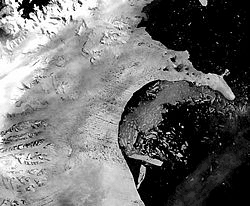
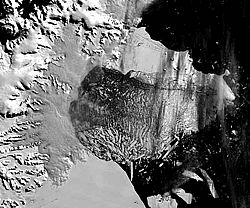
 The Antarctic Peninsula
is particularly
sensitive to small rises
in the annual average
temperature
The Antarctic Peninsula
is particularly
sensitive to small rises
in the annual average
temperature